
About Murry Taylor, in his own words

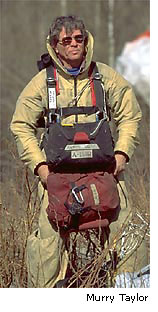 For the past thirty-one years (1975-2006) I've spent my winters living in the mountains of Northern California at the eastern edge of the Marble Mountain Wilderness. I built a log home on forty acres of timber there, and from October to April spend my time writing, practicing labor intensive forest management, and participating in local conservation issues.
My career eating smoke began the summer of 1959 on the Sierra National Forest as a member of the Clearwater slash disposal/fire crew. I loved the mountains, the work, everything about the job--especially fighting fire.
I started smokejumping in 1965 in Redding, California--a rookie class renowned (at least by us) as the greatest in history. Floyd Whitaker, Charlie Caldwell, Andy Anderson, Rich Englefield, and I were rookie bros and all heros the first season. For the next six years I took part in the the Region 5 refresher program. It didn't take long until we were known as the "Retreads". Each spring we'd return to Redding for one week of units and practice jumps. Then later we'd be called back in off our respective districts when they were short-handed. During the remainder of my retread years I worked as a forester for the U.S. Forest Service in both timber and recreation. By 1972 I was a GS-9 and spending almost all my time in the office going nuts and becoming disenchanted with the outfit. Worst of all, they told me no more retread jumping, that fire was not for "professionals", and that I needed to settle down and focus on becoming a District Ranger.
Billy Bowles, Don Weter, and Bobby Karr had left Redding Smokejumpers and transferred to Alaska. It occurred to me that I could quit the Forest Service and jump a couple more seasons in Alaska, and then return to my career and give up smokejumping once and for all. In 1973 I got on the Alaska crew and loved it so much I never looked back. I jumped there until 1978. Those years were what we called the "T-Hanger Days". They were some of the greatest of my life as far as people and jumping. Free-wheeling and wild, Alaska was a blast. The T-Hangar days are the setting for my second novel, More
or Less Crazy. I spent my winters in Baja and on the west coast of Mexico living on the beach. I made more money in five months jumping than I did working year-round as a forester, and had more fun with people I liked better.
From 1979 to 1986 I dropped out of jumping and worked on my land logging with draft horses and testifying before the County Board of Supervisors regarding soil erosion, degradation of fisheries habitat, and the threat to bio-diversity caused by National Forest logging policies. During that same time I helped establish and became a member of the Scott Valley Eleven, a land-use planning group. After two years of intensive political jostling between the local citizenry, the U.S. Forest Service, the California Department of Fish and Game, the Department of Forestry, the U.S. Soil Conservation Service, the California Water Quality Control Board, the County Board of Supervisors, and local logging interests, we produced the Scott Valley Area Plan--the first specific area plan adopted in the State of California. The plan is still in place today.
In twenty-seven years of smokejumping I've jumped fires in seven of the western states, Alaska, and Canada. I have 375 total jumps, and my last year, 2000, I finally made my
205th fire jump. A major part of my life has been spent working with and coming to know many of the key players at jump bases around the country. I not only know them as smokejumpers, but in a more personal sense, I have been privileged to know them as people with broken hearts, broken bodies, failed marriages, and when dealing with the death of friends and comrades.
The story of smokejumping is a story of extraordinary human endeavor; a story that strongly embraces the tenet that there is virtue in trying hard, keeping the faith, and never giving up. It's the story that inspired my first book, the memoir, Jumping fire and my subsequent fire novels, More or Less Crazy and Too Steep and Too Rough. My first novel, The Rhythm of Leaves explores a different subject matter entirely.
It took nine years and ten thousand hours to complete Jumping Fire. I felt compelled to write this book because there had simply been too many great characters and too many great stories to allow them to be lost forever in the wind. I don't claim this to be the complete story of smokejumping by any stretch of imagination. There is much too much to include in one book. What I did try to do was to tell the story from the inside as it is sensed and enjoyed from the jumpers point of view. I wanted to get away from the typical macho, GI Joe, elite battalion stereotypes. In our deeper humanity is where the real story lies, and it's what I've tried to capture. For those who have been smokejumpers, I wrote this book for you so that you could more completely share smokejumping with those close to you outside the experience. I hope you enjoy it.

Murry A. Taylor began his smokejumping career 1965. He divides his time between Alaska and northern California. Jumping Fire is his first book. Taylor's e-mail address is: murrytay@sisqtel.net All photographs by Mike McMillan Spotfire Images | Site Maintained by Ashland Websites